
We live in a global village.
We want our students to be dynamic and have available to them the greatest possibilities wherever life takes them. Our unique curriculum is designed to give them just that - variety, flexibility, and subject mastery.
High School Transition
In grade 9, students enter high school which means all of the topics they studied in middle school, will now be dealt with in a more substantial manner. All courses follow the American National Common Core standards. The curriculum is accredited by AdvancED.
GCSE Preparation
International students who wish to prepare for GCSE exams may note that much of the core content for Science, Math, and English are similar to equivalent GCSE courses; however, students are encouraged to enroll in local prep courses for specific test strategies.
Harmonizing Faith & World-Class Academics
Core Curriculum Explorer
Explore our rigorous, standard-aligned coursework designed for subject mastery.
Algebra I
Students in grade 9 take Algebra I or Geometry (if they have already completed Algebra I). Algebra I builds students’ command of linear, quadratic, and exponential relationships. Students learn through discovery and application, developing the skills they need to break down complex challenges and demonstrate their knowledge in new situations. This course is built for the Common Core State Standards for Mathematics.
- UNIT 1: FOUNDATIONS OF ALGEBRA
- UNIT 2: SOLVING EQUATIONS AND INEQUALITIES
- UNIT 3: FUNCTIONS
- UNIT 4: LINEAR EQUATIONS
- UNIT 5: SYSTEMS OF LINEAR EQUATIONS
- UNIT 6: EXPONENTS AND EXPONENTIAL FUNCTIONS
- UNIT 7: SEQUENCES AND FUNCTIONS
- UNIT 8: POLYNOMIALS
- UNIT 9: FACTORING POLYNOMIALS
- UNIT 10: QUADRATIC EQUATIONS AND FUNCTIONS
- UNIT 11: UNDOING FUNCTIONS AND MOVING THEM AROUND
- UNIT 12: DESCRIPTIVE STATISTICS
- UNIT 13: DATA AND MATHEMATICAL MODELING
Geometry
Geometry builds upon students’ command of geometric relationships and formulating mathematical arguments. Students learn through discovery and application, developing the skills they need to break down complex challenges and demonstrate their knowledge in new situations. This course is built to State Standards for Mathematics.
- UNIT 1: FOUNDATIONS OF GEOMETRY
- UNIT 2: TRIANGLES
- UNIT 3: RIGHT TRIANGLES
- UNIT 4: TRIGONOMETRY
- UNIT 5: QUADRILATERALS AND OTHER POLYGONS
- UNIT 6: CIRCLES WITHOUT COORDINATES
- UNIT 7: COORDINATE GEOMETRY
- UNIT 8: CONIC SECTIONS
- UNIT 9: CONSTRUCTIONS AND TRANSFORMATIONS
- UNIT 10: THREE-DIMENSIONAL SOLIDS
- UNIT 11: APPLICATIONS OF PROBABILITY
Algebra II
Algebra II introduces students to advanced functions, with a focus on developing a strong conceptual grasp of the expressions that define them. This course supports all students as they develop computational fluency and deepen conceptual understanding. Students begin each lesson by discovering new concepts through guided instruction, and then confirm their understanding in an interactive, feedback-rich environment. Modeling activities equip students with tools for analyzing a variety of real-world scenarios and mathematical ideas.
- UNIT 1: EXPRESSIONS, EQUATIONS AND INEQUALITIES
- UNIT 2: FUNCTIONS AND RELATIONS
- UNIT 3: QUADRATIC FUNCTIONS
- UNIT 4: TRANSFORMING FUNCTIONS
- UNIT 5: POLYNOMIAL FUNCTIONS
- UNIT 6: RATIONAL EXPRESSIONS AND FUNCTIONS
- UNIT 7: RADICAL EXPRESSIONS AND FUNCTIONS
- UNIT 8: EXPONENTIAL AND LOGARITHMIC FUNCTIONS
- UNIT 9: STATISTICAL ANALYSIS
- UNIT 10: TRIGONOMETRY
Precalculus
Precalculus is a course that combines reviews of algebra, geometry, and functions into a preparatory course for calculus. The course focuses on the mastery of critical skills and exposure to new skills necessary for success in subsequent math courses. The course is built to state standards and the National Council of Teachers of Mathematics (NCTM) standards.
- UNIT 1: FUNCTIONS
- UNIT 2: QUADRATIC FUNCTIONS
- UNIT 3: POLYNOMIAL AND RATIONAL FUNCTIONS
- UNIT 4: EXPONENTIAL AND LOGARITHMIC FUNCTIONS
- UNIT 5: CONIC SECTIONS
- UNIT 6: SEMESTER 1 REVIEW AND EXAM
- UNIT 7: INTRODUCTION TO TRIGONOMETRY
- UNIT 8: TRIGONOMETRIC FUNCTIONS
- UNIT 9: WORKING WITH TRIGONOMETRIC FUNCTIONS
- UNIT 10: TRIGONOMETRIC IDENTITIES
- UNIT 11: APPLICATIONS OF TRIGONOMETRY
- UNIT 12: COMPLEX NUMBERS
English I
The English I is grade 9 high school english. The course is an overview of exemplary selections of literature in fiction and nonfiction genres. Students read short stories, poems, a full-length novel, and a full-length Shakespeare plays, analyzing the use of elements of literature in developing character, plot, and theme.
- UNIT 1: THE SHORT STORY, PART 1
- UNIT 2: THE SHORT STORY, PART 2
- UNIT 3: POETRY
- UNIT 4: THE NOVELLA: FRANZ KAFKA'S THE METAMORPHOSIS
- UNIT 5: DRAMA: SHAKESPEARE'S MACBETH
- UNIT 6: THE RHETORIC OF ARGUMENT
- UNIT 7: THE RHETORIC OF SPEECHES
- UNIT 8: REINTERPRETING FICTION
English II
The focus of English II, taken during the 10th grade, focuses on the writing process. This course follows the model of English 9 by including at least one anchor text per lesson, but the essays, articles, stories, poems, and speeches are often presented as models for students to emulate as they practice their own writing. English 10 also continues to develop reading, listening, and speaking skills.
- UNIT 1: THE WRITTEN WORD
- UNIT 2: THE STORY
- UNIT 3: LITERARY CRITICISM
- UNIT 4: THE RESEARCH PAPER
- UNIT 5: PRACTICAL DOCUMENTS
- UNIT 6: PERSUASIVE TEXTS
- UNIT 7: THE SPEECH
- UNIT 8: RESEARCHED ARGUMENTATION
English III
In the English III course, students examine the belief systems, events, and literature that have shaped the United States. They explore how the Romantics and Transcendentalists emphasized the power and responsibility of the individual, examine the Modernists’ disillusionment, and analyze a wide range of literature, both fiction and nonfiction, to understand our multicultural identity.
- UNIT 1: THE AMERICAN REVOLUTION
- UNIT 2: ROMANTICISM AND TRANSCENDENTALISM
- UNIT 3: THE AMERICAN NARRATIVE
- UNIT 4: MODERNISM AND THE AMERICAN DREAM
- UNIT 5: MODERNISM AND LANGUAGE
- UNIT 6: REDEFINING HOME
- UNIT 7: FRACTURED IDENTITIES
- UNIT 8: THE INFLUENCE OF SCIENCE AND TECHNOLOGY
Biology
Biology focuses on the mastery of basic biological concepts and models while building scientific inquiry skills and exploring the connections between living things and their environment.
- UNIT 1: INTRODUCTION TO BIOLOGY
- UNIT 2: THE CHEMISTRY OF BIOLOGY
- UNIT 3: CELLS
- UNIT 4: ENERGY TRANSFER
- UNIT 5: EARTH’S RESOURCES
- UNIT 6: DNA AND HEREDITY
- UNIT 7: DNA TO PROTEIN
- UNIT 8: ECOSYSTEMS AND NATURAL SELECTION
- UNIT 9: EVOLUTION AND CLASSIFICATION
- UNIT 10: HUMAN BIOLOGY END OF THE YEAR REVIEW
Physical Science
Physical Science curriculum is designed around the understanding critical physical science concepts, including the nature and structure of matter, the characteristics of energy, and the mastery of critical scientific skills. Course topics include an introduction to kinematics, including gravity and two-dimensional motion; force; momentum; waves; electricity; atoms; the periodic table of elements; molecular bonding; chemical reactivity; gases; and an introduction to nuclear energy.
- UNIT 1: INTRO TO SCIENCE
- UNIT 2: MOTION
- UNIT 3: FORCES
- UNIT 4: ENERGY
- UNIT 5: WAVES
- UNIT 6: ELECTRICITY
- UNIT 7: REVIEW AND EXAM
- UNIT 8: ELEMENTS
- UNIT 9: BONDS
- UNIT 10: CHEMICAL REACTIONS
- UNIT 11: GAS
- UNIT 12: NUCLEAR ENERGY
Chemistry
G11 Chemistry offers a curriculum that emphasizes students’ understanding of fundamental chemistry concepts while helping them acquire tools to be conversant in a society highly influenced by science and technology. Throughout this course, students are given an opportunity to understand how chemistry concepts are applied in technology and engineering.
- UNIT 1: CHEMISTRY AND SOCIETY
- UNIT 2: ATOMIC STRUCTURE
- UNIT 3: BONDING IN MATTER
- UNIT 4: CHEMICAL REACTIONS
- UNIT 5: CHEMISTRY AT WORK
- UNIT 6: ENERGY IN MATTER
- UNIT 7: EQUILIBRIUM AND KINETICS
- UNIT 8: TRANSFERRING ENERGY
- UNIT 9: QUANTUM AND NUCLEAR CHEMISTRY
- UNIT 10: ENERGY IN ORGANIC MOLECULES
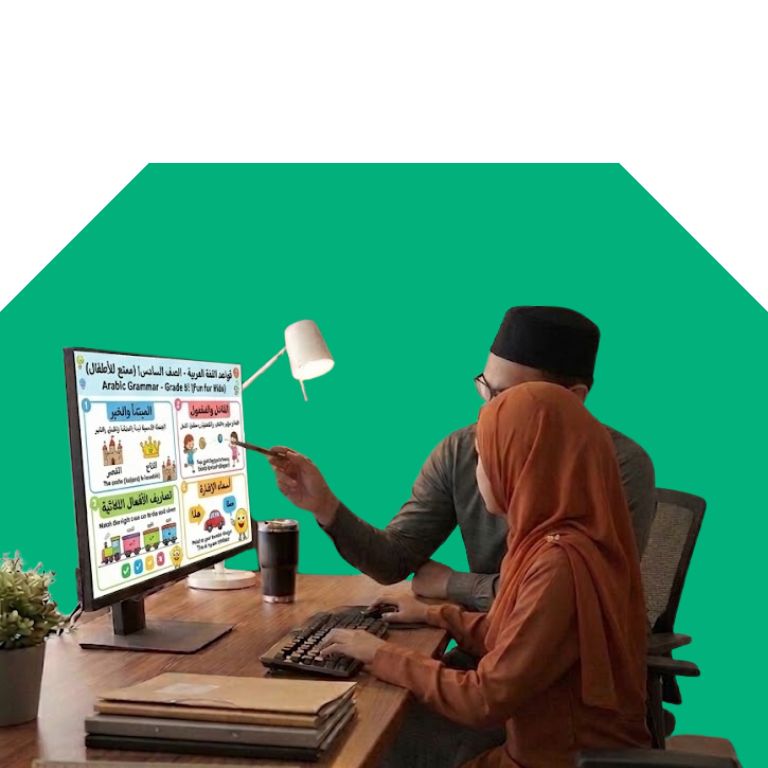
Arabic Language
Arabic program at Bayaan is an immersion program with a focus on spoken and written Arabic, Quranic vocabulary with proper usage of grammar, and Arabic comprehension. Students also dedicate a small portion of the class learning the fundamentals of Arabic grammar, morphology, and translation methods. Teachers and students have to converse in Arabic during the Arabic Language class. Curriculum series from Arabiyyah Bayna Yadayk are used as the main resource.
- IMMERSION & SPEAKING
- QURANIC VOCABULARY
- GRAMMAR & USAGE
- MORPHOLOGY
- TRANSLATION METHODS
- ARABIYYAH BAYNA YADAYK SERIES
Islamic Studies
For our Seasoned Travelers, a separate Boy/Girl curriculum has also been devised. They are demanded to critically analyze deeper concepts, such as comprehensive Surahs of the Quran, examining Islamic History and concepts around the end times/ the unseen world, and matters concerning personal worship (such as hijab for girls, the value of time, societal conduct, financial transactions, etc). Through delving into a thematic Quran Tafseer, connecting events in Surah Yusuf and Surah al-Kahf to their own lived experience, and looking at the lives of the pious men and women of the past, students build a healthy connection to righteous role-models.
- COMPREHENSIVE SURAHS OF THE QURAN
- ISLAMIC HISTORY
- THE UNSEEN WORLD & END TIMES
- PERSONAL WORSHIP & SOCIETAL CONDUCT
- THEMATIC QURAN TAFSEER (YUSUF & AL-KAHF)
- LIVES OF PIOUS ROLE-MODELS
Self-Paced Electives
Flexible elective offerings designed to broaden every student's horizons.
Physical Education
Physical Education combines the best of online instruction with actual student participation in weekly cardiovascular, aerobic, and muscle toning activities. The course promotes a keen understanding of the value of physical fitness.
- UNIT 1: P.E. DESIGNED FOR ME
- UNIT 2: IS MY BODY GOOD TO GO?
- UNIT 3: GREAT FOR THE HEART
- UNIT 4: FITNESS ADVENTURE
Health
Health is a valuable, skills-based health education course designed for general education in grades 9 through 12. Health helps students develop knowledge, attitudes, and essential skills in a variety of health-related subjects.
- UNIT 1: MENTAL AND EMOTIONAL HEALTH
- UNIT 2: FITNESS AND NUTRITION
- UNIT 3: DRUGS
- UNIT 4: DISEASE
- UNIT 5: INJURIES
Principles of Health Science
Principles of Health Science provides knowledge and skills students need for careers in health care. Students explore the services, structure, and professions of the health care system and get guidance on choosing a specific career path.
- UNIT 1: HEALTH, DISEASE, AND INDUSTRY
- UNIT 2: CAREERS IN HEALTH SCIENCES
- UNIT 3: TEAMWORK IN HEALTH CARE
- UNIT 4: COMMUNICATION AND RECORDS
- UNIT 5: SAFETY AND WELLNESS
- UNIT 7: THE BODY IN HARMONY
- UNIT 8: TOOLS OF THE TRADE
- UNIT 9: PATIENT SAFETY
- UNIT 10: EMERGENCIES
Bridge Math
Bridge Math is a fourth-year math course focused on reinforcing core concepts from Algebra I, Geometry and Algebra II. It is intended for students who need to review concepts before continuing their studies.
- UNIT 1: FOUNDATIONS OF ALGEBRA
- UNIT 2: FUNCTIONS
- UNIT 3: SYSTEMS OF LINEAR EQUATIONS
- UNIT 4: QUADRATIC FUNCTIONS
- UNIT 5: POLYNOMIAL FUNCTIONS
- UNIT 7: EXPONENTS AND EXPONENTIAL FUNCTIONS
- UNIT 8: TRIANGLES
- UNIT 9: 2-D AND 3-D GEOMETRY
- UNIT 10: APPLICATIONS OF PROBABILITY
Liberal Arts Mathematics 1
Addresses the need for an elective course that focuses on reinforcing, deepening, and extending a student's mathematical understanding. Starts with a review of problem-solving skills.
- UNIT 1: SOLVING EQUATIONS AND INEQUALITIES
- UNIT 2: FUNCTIONS
- UNIT 3: LINEAR EQUATIONS
- UNIT 4: EXPONENTS AND EXPONENTIAL FUNCTIONS
- UNIT 5: POLYNOMIALS
- UNIT 6: QUADRATIC EQUATIONS
- UNIT 9: DESCRIPTIVE STATISTICS
- UNIT 10: FOUNDATIONS OF GEOMETRY
Liberal Arts Mathematics 2
Starts with a review of algebraic concepts before moving on to a variety of key algebraic, geometric, statistical and probability concepts.
- UNIT 1: FOUNDATIONS OF ALGEBRA
- UNIT 2: QUADRATIC FUNCTIONS
- UNIT 3: POLYNOMIAL FUNCTIONS
- UNIT 4: EXPONENTIAL AND LOGARITHMIC FUNCTIONS
- UNIT 6: SEQUENCES AND FUNCTIONS
- UNIT 7: TRIGONOMETRY
- UNIT 8: COORDINATE GEOMETRY
- UNIT 9: STATISTICAL ANALYSIS
- UNIT 10: APPLICATIONS OF PROBABILITY
Probability and Statistics
Provides a curriculum focused on understanding key data analysis and probabilistic concepts, calculations, and relevance to real-world applications.
- UNIT 1: INTRODUCTION TO STATISTICS
- UNIT 2: DESCRIBING DATA GRAPHICALLY
- UNIT 3: MEASURES OF CENTER AND SPREAD
- UNIT 4: DESCRIBING DATA SETS
- UNIT 5: MODELING DATA
- UNIT 7: INTRODUCTION TO PROBABILITY
- UNIT 8: APPLICATIONS OF PROBABILITY
- UNIT 9: DISCRETE PROBABILITY DISTRIBUTIONS
- UNIT 10: CONTINUOUS PROBABILITY DISTRIBUTIONS
Mathematics of Personal Finance
Mathematics of Personal Finance focuses on real-world financial literacy, personal finance, and business subjects. Students apply what they learned in Algebra I and Geometry to topics including personal income, taxes, and credit.
- UNIT 1: WHAT IS MONEY?
- UNIT 2: COST OF LIVING AND BUDGET
- UNIT 3: INCOME TAX
- UNIT 4: CHECKING AND SAVINGS
- UNIT 5: PURCHASING AND CREDIT
- UNIT 6: LOANS AND PAYMENTS
- UNIT 8: CAR OWNERSHIP
- UNIT 9: HOME OWNERSHIP
- UNIT 10: INSURANCE AND RETIREMENT
- UNIT 11: INVESTMENTS
- UNIT 12: BUSINESS
Information Technology Apps
Prepares students to work in the field of Information Technology. Students will be able to demonstrate digital literacy through basic study of computer hardware, OS, and networking.
- UNIT 1: INFORMATION TECHNOLOGY
- UNIT 2: COMPUTER HARDWARE AND SOFTWARE
- UNIT 3: SPREADSHEETS AND DATABASES
- UNIT 4: INFORMATION SYSTEMS AND NETWORKING
- UNIT 5: EXPLORING THE WEB
Accounting I
Examines how to make decisions about planning, organizing, and allocating resources using accounting procedures. Focuses on double-entry accounting.
- UNIT 1: WHAT IS ACCOUNTING?
- UNIT 2: WHAT IS THE ACCOUNTING CYCLE?
- UNIT 3: REGULATION AND ETHICS IN ACCOUNTING
- UNIT 4: WHAT ARE INTERNAL AND CASH CONTROLS?
- UNIT 5: MERCHANDISING BUSINESSES AND INVENTORIES
- UNIT 7: PAYABLES AND RECEIVABLES
- UNIT 8: PAYROLL
- UNIT 9: ACCOUNTING FOR CORPORATIONS
- UNIT 10: FINANCIAL STATEMENT ANALYSIS I
Accounting II
Builds on the foundation acquired in Accounting I, allowing students to extend their skills and knowledge. Focuses on managerial, financial, and operational activities.
- UNIT 1: ACCOUNTING REGULATION AND ETHICS
- UNIT 2: OVERVIEW OF FINANCIAL ACCOUNTING
- UNIT 3: CORPORATIONS AND OTHER TYPES OF BUSINESSES
- UNIT 4: FINANCIAL STATEMENTS
- UNIT 6: INTRODUCTION TO MANAGERIAL ACCOUNTING
- UNIT 7: COST ACCOUNTING ANALYSIS
- UNIT 8: FINANCIAL PLANNING
- UNIT 9: CAPITAL BUDGETING
- UNIT 10: CORPORATE BUSINESS DECISIONS
Business, Marketing & Finance
Provides the knowledge and skills students need for careers in business and marketing. Students begin exploring roles and functions that business and marketing play in a global society.
- UNIT 1: MARKETING IN THE GLOBAL ENVIRONMENT
- UNIT 2: UNDERSTANDING THE MARKETPLACE
- UNIT 3: MARKETING PLACEMENT AND PRICING
- UNIT 4: MARKETING PROMOTION
- UNIT 5: YOUR FUTURE IN MARKETING
- UNIT 7: ROLE OF ECONOMICS AND FINANCE IN MARKETING
- UNIT 8: STARTING A BUSINESS
- UNIT 9: MANAGING A BUSINESS
- UNIT 10: GOVERNMENT, LAW, AND ETHICS IN BUSINESS
Legal Environment of Business
Examines the role of the law on all aspects of business ownership and management, focusing on legal ethics, court procedures, torts, and contracts.
- UNIT 1: AN OVERVIEW OF BUSINESS LAW AND ETHICS
- UNIT 2: THE LEGAL SYSTEM
- UNIT 3: TORTS
- UNIT 4: CONTRACTS
- UNIT 5: LAWS GOVERNING BUSINESS ORGANIZATIONS
- UNIT 7: CONSUMER AND CREDITOR PROTECTION
- UNIT 8: PROPERTY LAW
- UNIT 9: AGENCY, EMPLOYMENT LAW, AND DIGITAL PROTECTION
- UNIT 10: ENVIRONMENTAL AND INTERNATIONAL LAW
Human Resources Principles
Examines the main functions of human resources management, including planning, recruitment, selection, training, development, compensation, and evaluation.
- UNIT 1: WHAT IS HR?
- UNIT 2: LEGAL REQUIREMENTS
- UNIT 3: HR PLANNING
- UNIT 4: RECRUITMENT AND SELECTION
- UNIT 5: COMPENSATION
- UNIT 7: TRAINING AND DEVELOPMENT
- UNIT 8: CULTIVATING AND TERMINATING EMPLOYEE RELATIONSHIPS
- UNIT 9: PERFORMANCE MANAGEMENT
- UNIT 10: SAFETY, SECURITY, AND LABOR RELATIONS
Intro to Business and Tech
Provides the foundational knowledge and skills students need for careers in business and technology. Students gain knowledge of business principles and communication skills.
- UNIT 1: UNDERSTANDING BUSINESS CAREERS
- UNIT 2: COMMUNICATING THROUGH LETTERS AND EMAILS
- UNIT 3: COMMUNICATING THROUGH FORMAL BUSINESS DOCUMENTS
- UNIT 4: COMMUNICATING THROUGH PRESENTATIONS
- UNIT 6: FINANCE, SPREADSHEETS, AND DATABASES
- UNIT 7: BUSINESS MARKETING
- UNIT 8: INFORMATION TECHNOLOGY, SYSTEMS, AND NETWORKING
- UNIT 9: EXPLORING THE WEB
Principles of Info Tech
Prepares students by establishing an awareness of the roles essential to an organization’s success, and then work to develop an understanding of professional communications and leadership skills.
- UNIT 1: UNDERSTANDING BUSINESS CAREERS
- UNIT 2: COMMUNICATING THROUGH LETTERS AND EMAIL
- UNIT 3: FORMAL BUSINESS DOCUMENTS
- UNIT 4: COMMUNICATING THROUGH PRESENTATIONS
- UNIT 5: MANAGING PROJECTS
- UNIT 7: INFORMATION TECHNOLOGY
- UNIT 8: COMPUTER HARDWARE AND SOFTWARE
- UNIT 9: SPREADSHEETS AND DATABASES
- UNIT 10: INFORMATION SYSTEMS AND NETWORKING
- UNIT 11: EXPLORING THE WEB
Business Applications
An introduction to software applications that prepare students to succeed in the workplace. Covers professional communications, email, and presentation software.
- UNIT 1: UNDERSTANDING BUSINESS CAREERS
- UNIT 2: COMMUNICATING THROUGH LETTERS AND EMAIL
- UNIT 3: FORMAL BUSINESS DOCUMENTS
- UNIT 4: COMMUNICATING THROUGH PRESENTATIONS
- UNIT 5: MANAGING PROJECTS
College and Career Prep I
High school students have many questions about the college application process, what it takes to be a successful college student, and how to begin thinking about their career.
- UNIT 1: PREPARE FOR COLLEGE IN HIGH SCHOOL
- UNIT 2: COLLEGE KNOWLEDGE
- UNIT 3: TESTING AND ASSESSMENTS
- UNIT 4: FINANCIAL AID
- UNIT 5: CAREER OPPORTUNITIES
- UNIT 6: COLLEGE AND CAREER PREPARATION
Financial Literacy
Financial Literacy helps students recognize and develop vital skills that connect life and career goals with personalized strategies and milestone-based action plans. Students explore concepts and work toward a mastery of personal finance skills.
- UNIT 1: GOALS AND CAREER PLANNING
- UNIT 2: INCOME AND BUDGETING
- UNIT 3: BANKING
- UNIT 4: SAVINGS AND INVESTMENT
- UNIT 5: CREDIT
- UNIT 6: CONSUMER PURCHASING AND PROTECTION
Psychology
Psychology provides a solid overview of the field's major domains: methods, biopsychology, cognitive and developmental psychology, and variations in individual and group behavior.
- UNIT 1: PSYCHOLOGY AS A SCIENCE
- UNIT 2: THE BRAIN AND THE BODY
- UNIT 3: THINKING, FEELING, AND CONSCIOUSNESS
- UNIT 4: DEVELOPING THROUGHOUT LIFE
- UNIT 5: SOCIAL PSYCHOLOGY
- UNIT 6: DISORDERS AND WELLNESS
Sociology
Sociology examines why people think and behave as they do in relationships, groups, institutions, and societies. Built to the National Council for the Social Studies standards.
- UNIT 1: WHAT IS SOCIOLOGY?
- UNIT 2: WHAT IS SOCIETY?
- UNIT 3: WHAT IS SOCIAL INEQUALITY?
- UNIT 4: WHAT ARE SOCIAL INSTITUTIONS?
- UNIT 5: WHAT IS SOCIAL CHANGE?
Multicultural Studies
A one-semester elective history and sociology course that examines the United States as a multicultural nation, emphasizing the perspectives of diverse groups.
- UNIT 1: IDENTITY
- UNIT 2: CULTURE IN A MULTICULTURAL SOCIETY
- UNIT 3: RACE AND IDENTITY
- UNIT 4: THE MEDIA, RACE, AND IDENTITY
- UNIT 5: UNDERSTANDING AND ADDRESSING RACISM
Art Appreciation
A survey of the history of Western visual arts. Students learn the basic principles of painting and how to critique works of art, exploring prehistoric, Renaissance, and modern art.
- UNIT 1: INTRODUCTION TO PAINTING
- UNIT 2: PREHISTORIC TO LATE MIDDLE AGES
- UNIT 3: THE RENAISSANCE
- UNIT 4: BAROQUE AND ROCOCO
- UNIT 5: MODERNITY IN THE 19TH AND 20TH CENTURIES
- UNIT 6: BEYOND WESTERN INFLUENCE
Creative Writing
Focuses on the exploration of short fiction and poetry, culminating in a written portfolio. Students draft, revise, and polish fiction and poetry through writing exercises.
- UNIT 1: INTRODUCTION TO CREATIVE WRITING
- UNIT 2: FICTION, PART 2
- UNIT 3: FICTION, PART 3
- UNIT 4: POETRY, PART 1
- UNIT 5: POETRY, PART 2
- UNIT 6: POETRY, PART 3 AND REVISION
Media Literacy
Teaches students how to build the critical thinking, writing, and reading skills required in a media-rich and increasingly techno-centric world.
- UNIT 1: WHAT IS A NETWORKED WORLD?
- UNIT 2: HOW DO YOU READ IN A NETWORKED WORLD?
- UNIT 3: WHO ARE YOU IN A NETWORKED WORLD?
- UNIT 4: WHAT DO YOU CREATE IN A NETWORKED WORLD? PART 1
- UNIT 5: WHAT DO YOU CREATE IN A NETWORKED WORLD? PART 2
Reading Skills and Strategies
Designed to help the struggling reader develop mastery in the areas of reading comprehension, vocabulary building, study skills, and media literacy, which are the course’s primary content strands.
- UNIT 1: INTRODUCTION TO READING STRATEGIES
- UNIT 2: INTRODUCTION TO READING PROCESSES
- UNIT 3: READING FOR ENTERTAINMENT: FICTION
- UNIT 4: READING FOR INFORMATION: MAGAZINE ARTICLES
- UNIT 5: READING FOR INFORMATION: NEWSPAPERS
- UNIT 6: READING FOR INFORMATION: ESSAYS
- UNIT 7: READING TO COMPLETE A TASK
- UNIT 8: FUNCTIONAL DOCUMENTS
- UNIT 9: READING TO ANALYZE LITERATURE: POETRY
- UNIT 10: READING TO ANALYZE LITERATURE: PROSE
Writing Skills and Strategies
Develops key language arts skills necessary for high school graduation and success on high stakes exams through a semester of interactive instruction and guided practice in composition fundamentals.
- UNIT 1: INTRODUCTION TO WRITING STRATEGIES
- UNIT 2: THE BUILDING BLOCKS OF COMPOSITION
- UNIT 3: PARAGRAPHS: EXAMPLE AND ILLUSTRATION
- UNIT 4: PARAGRAPHS: PROCESS AND CAUSE-AND-EFFECT
- UNIT 5: PARAGRAPHS: DESCRIPTION AND CLASSIFICATION
- UNIT 6: ESSAYS: PERSONAL WRITING
- UNIT 7: ESSAYS: COMPARE-AND-CONTRAST
- UNIT 8: ESSAYS: PERSUASIVE WRITING
- UNIT 9: ESSAYS: WRITING ABOUT LITERATURE
- UNIT 10: WRITING IN THE WORKPLACE
Empowering Global Leaders of Tomorrow
At Bayaan Academy, our high school program goes beyond traditional learning. We provide a dynamic, future-ready environment where students build robust academic portfolios while staying firmly rooted in Islamic principles and moral excellence.
Why families trust our high school curriculum:
World History
In World History, students learn to see the world today as a product of a process that began thousands of years ago when humans became a speaking, traveling, and trading species. Through historical analysis grounded in primary sources, case studies, and research, students investigate the continuity and change of human culture, governments, economic systems, and social structures.
U.S. History
U.S. History traces the nation’s history from the pre-colonial period to the present. The course emphasizes the development of historical analysis skills such as comparing and contrasting, differentiating between facts and interpretations, considering multiple perspectives, and analyzing cause-and-effect relationships.
Geography and World Cultures
Geography and World Cultures offers a tightly focused and scaffolded curriculum that enables students to explore how geographic features, human relationships, political and social structures, economics, science and technology, and the arts have developed and influenced life in countries around the world. Along the way, students are given rigorous instruction on how to read maps, charts, and graphs, and how to create them.